🧠 Session Review
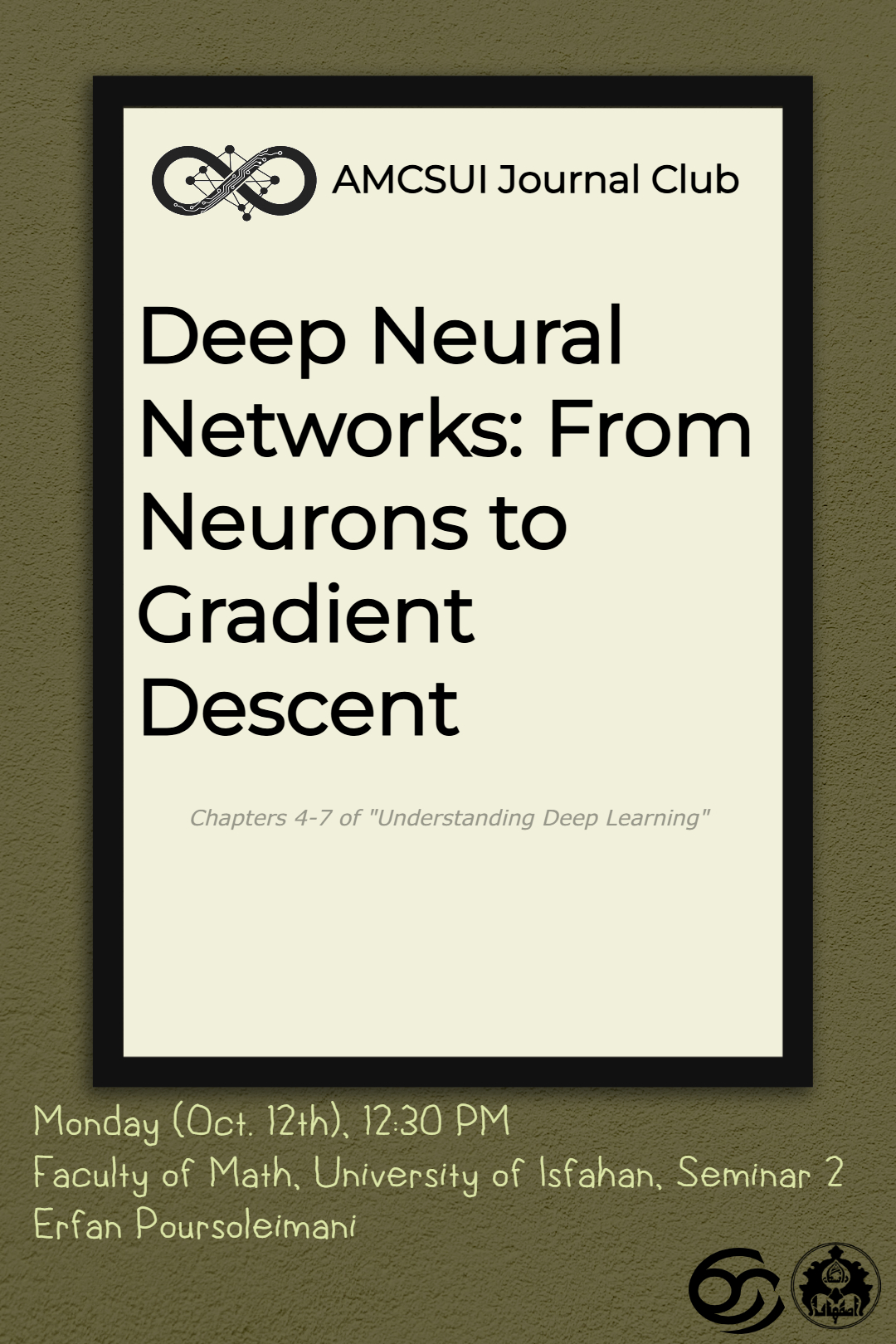
Session Title: Deep Neural Networks: From Neurons to Gradient Descent
Date: 12th October 2026
Presenter: Erfan Poursoleimani
Slides: Deep neural networks.pdf
Reviewed by: Erfan Poursoleimani
🗣️ Attendees
- Ali Ebrahimi
- Ali Fazel
- Amirhossein Shahsavari
- Erfan Poursoleimani
- Iliya Esteki
- Mahdi Heydari
- Reyhaneh Bagheri
🗣️ Discussion Questions
- What is an artificial neuron, and how do weights, biases, and activation functions work?
- Why are nonlinear activation functions essential for deep neural networks?
- How do layers combine to form a deep neural network?
- What is the difference between a loss function and an optimization objective?
- How do softmax, cross-entropy, and maximum likelihood relate to classification?
- What is gradient descent, and how does the learning rate affect optimization?
- What are the differences between SGD, momentum, Nesterov momentum, and Adam?
- How does the chain rule enable backpropagation?
- Why is weight initialization important, and how can vanishing and exploding gradients affect training?
- How do all these components work together during neural network training?
📝 Summary
We explored the foundations of deep neural networks, from individual neurons, activation functions, and multilayer architectures to forward propagation and loss functions. We examined softmax, cross-entropy, and maximum likelihood, then studied optimization methods including gradient descent, stochastic gradient descent (SGD), momentum, Nesterov momentum, and Adam. We also covered gradients, the chain rule, backpropagation, and weight initialization to understand how neural networks learn and optimize their parameters. Finally, we concluded the session by training a simple neural network and applying these concepts in practice.
💬 Discussion Highlights
We connected the mathematical foundations of neural networks to their practical training process. In particular, we examined how gradients guide parameter updates, how different optimization algorithms influence learning, and why initialization and gradient propagation matter when training deep architectures. The hands-on training of a simple neural network demonstrated how forward propagation, loss computation, backpropagation, and parameter optimization work together.