🧠 Session Review
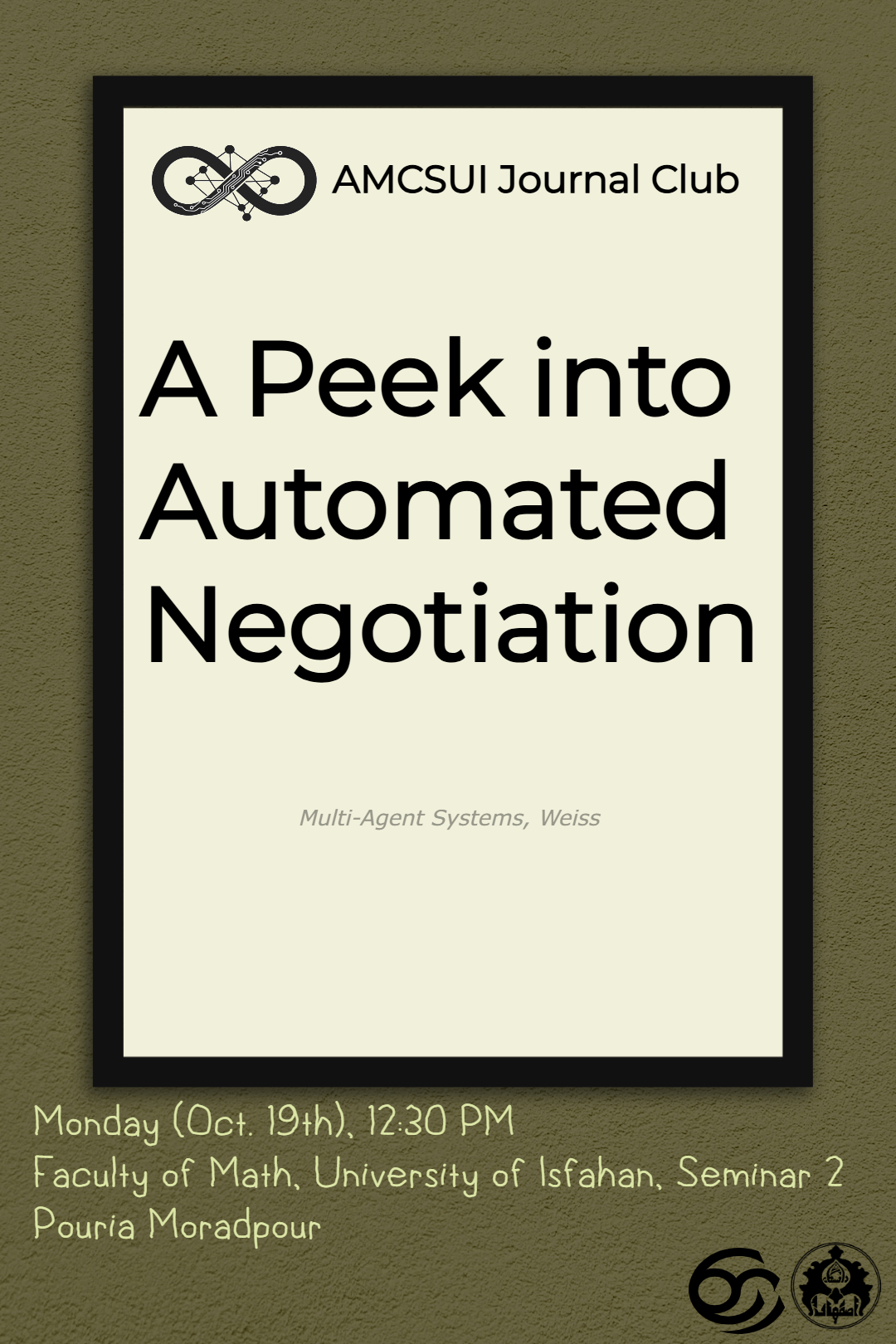
Session Title: A Peek into Automated Negotiation
Date: 19th October 2026
Presenter: Pouria Moradpour
Slides: A Peek into Automated Negotiation.pdf
Reviewed by: Pouria Moradpour
🗣️ Attendees
- Ali Soleimani
- Arman Riahi
- Erfan Jalali
- Erfan Poursoleimani
- Mahdi Meskin
- Pouria Moradpour
- Shayan Najafian
🗣️ Discussion Questions
- What is automated negotiation, and why is it important in multi-agent systems?
- How do autonomous agents negotiate when they have conflicting goals and preferences?
- What are the main components of a negotiation model, including issues, utility functions, protocols, and strategies?
- How does multi-issue negotiation differ from single-issue negotiation, and how can trade-offs lead to mutually beneficial agreements?
- What are the roles of bidding strategies, acceptance strategies, and opponent modeling in automated negotiation?
- How can personality traits influence an agent’s negotiation behavior, and how does the OCEAN model represent these traits?
- How are risk and cooperation factors incorporated into personality-based bargaining strategies?
- Why is opponent preference modeling challenging when agents have incomplete information about each other’s utility functions?
- How does POPPONENT use perceptron units and incremental gradient descent to estimate an opponent’s preferences?
- What are the advantages and limitations of personality-based bargaining and learning-based opponent modeling?
📝 Summary
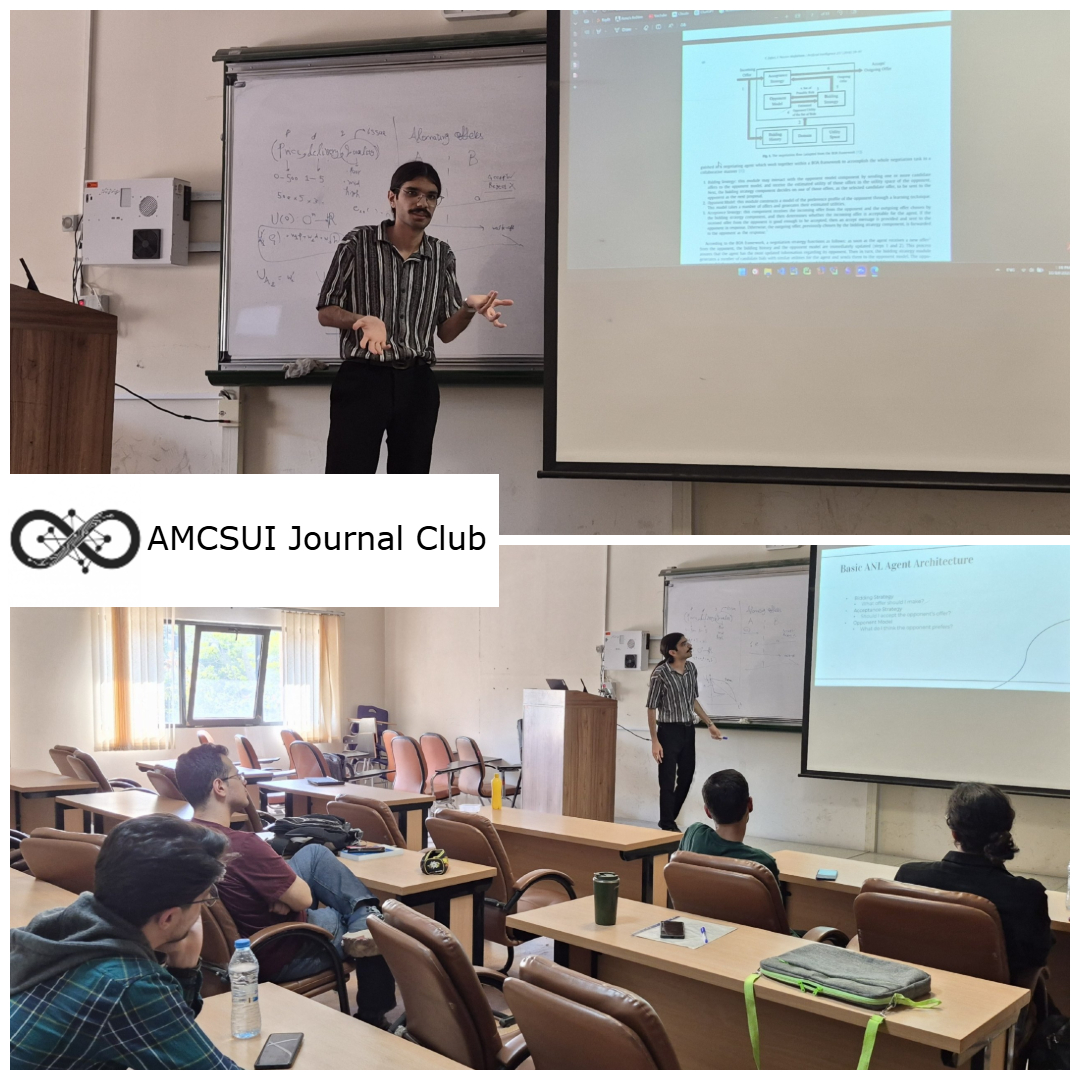
We explored the foundations of automated negotiation in multi-agent systems, beginning with how autonomous agents with different preferences and goals reach agreements through offers and counteroffers. We examined the basic negotiation model, including negotiation issues, outcome spaces, utility functions, protocols, and strategies. We discussed the differences between single-issue and multi-issue negotiation, the role of trade-offs in reaching mutually beneficial agreements, and common concession strategies such as Boulware, Conceder, and Linear. We also introduced the Automated Negotiating Agents Competition (ANAC) and the Automated Negotiation League (ANL), focusing on how negotiating agents are designed and evaluated.
Following the introductory slides, we took a deeper look at two research papers. The first, A Heuristic Personality-Based Bilateral Multi-Issue Bargaining Model in Electronic Commerce, explored how the OCEAN personality model can be incorporated into automated bargaining through risk and cooperation factors, fuzzy inference, and personality-dependent decision-making. The second, POPPONENT: Highly Accurate, Individually and Socially Efficient Opponent Preference Model in Bilateral Multi Issue Negotiations, introduced a perceptron-based approach to learning an opponent’s preferences from exchanged offers using multi-bipartite incremental gradient descent. Together, these papers provided two perspectives on designing negotiating agents: modeling agents’ behavioral characteristics and learning about their opponents.
🧾 References & Resources
- Multi-Agent Systems: A Modern Approach to Distributed Artificial Intelligence - Gerhard Weiss (Editor)
- A Heuristic Personality-Based Bilateral Multi-Issue Bargaining Model in Electronic Commerce — Nassiri-Mofakham et al. (2009)
- POPPONENT: Highly Accurate, Individually and Socially Efficient Opponent Preference Model in Bilateral Multi Issue Negotiations — Zafari & Nassiri-Mofakham (2016)